National Capital Territory · India
Delhi
India’s capital territory, explored as a collection of capitals, neighbourhoods, and living heritage.
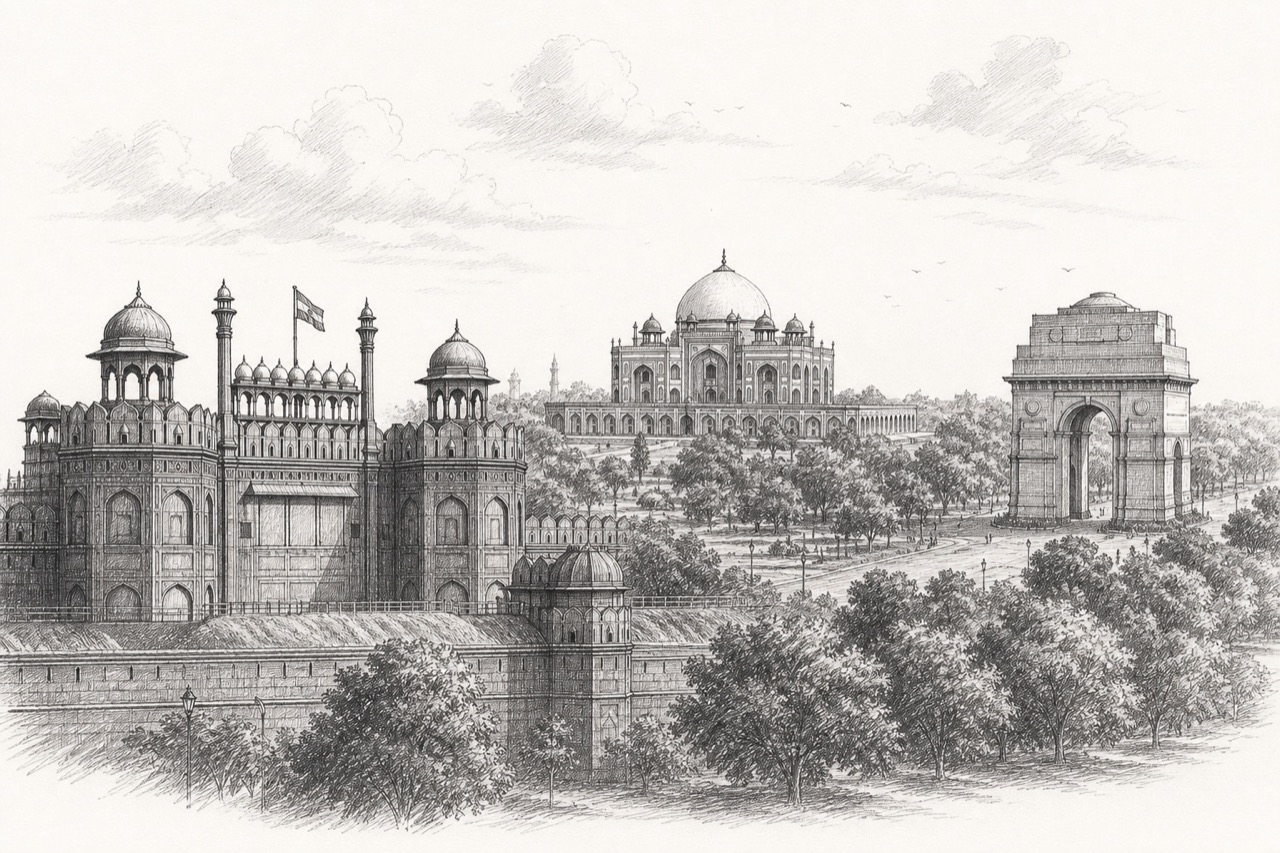
One canonical city journal
Everything for Delhi, together
India’s capital territory, explored as a collection of capitals, neighbourhoods, and living heritage.
This page consolidates the city’s writing, photographs, mapped stops, practical detail, and locally matched saved places. Regional route pages remain useful for wider context, but this is the stable journal URL for Delhi.
India trip planner · quick orientation
Plan a trip to Delhi
This journal already contains a detailed neighbourhood-by-neighbourhood guide. Use this compact card for the essentials, then choose one route rather than reading or visiting everything in sequence.
Plan one geographic cluster per half or full day, use the metro or established transport for longer jumps, and keep extra time for security queues, traffic, heat or winter fog. Verify current monument entry rules and transport schedules shortly before travelling.
Wikivoyage sources, contributors and CC BY-SA 4.0 licence
The August 2026 English Wikivoyage dump contains a geographically validated guide for Delhi. This planner reorganises durable orientation from that guide and combines it with Delhi’s verified place bundle. Timetables, prices and individual business details are not treated as permanent facts.
This adapted planning guide uses the 2026-08-01 English Wikivoyage dump. Source revisions:
The adapted guide text inside this section is available under the Creative Commons Attribution-ShareAlike 4.0 licence. It has been condensed, reorganised and combined with Traveling Gander’s independent map data. No Wikivoyage images were reused. See Wikivoyage’s reuse guidance.
Consolidated journal
Descriptions, photographs, and details
The entry below preserves the useful material that previously lived on an independent journal page.
Orientation
The shape of Delhi
Delhi makes more sense as an archive of capitals than as one continuous city. Lal Kot and Qila Rai Pithora anchor the Rajput beginning; the Delhi Sultanate moved through Mehrauli, Siri, Tughlaqabad, Jahanpanah, and Ferozabad. The Mughals added Dinpanah and Shahjahanabad. New Delhi arrived in the twentieth century with ceremonial vistas, roundabouts, and bungalow-lined avenues.
These layers are still legible. A broad civic axis becomes a shaded garden; a garden becomes a shrine quarter; a metro ride ends among medieval walls. The most satisfying way to travel is one geographic cluster at a time, leaving enough room for the city between the monuments.
Suggested rhythm
Choose a route, not a race
The civic axis
Rashtrapati Bhavan, Vijay Chowk, Kartavya Path, India Gate, the National War Memorial, and nearby museums.
Central arts
Connaught Place, Jantar Mantar, Agrasen ki Baoli, Mandi House, Gandhi Smriti, and Lodi Gardens.
Shahjahanabad
Red Fort, Chandni Chowk’s street of faiths, Jama Masjid, specialist bazaars, the old gates, and Rajghat.
Nizamuddin
Humayun’s Tomb, Sunder Nursery, the shrine quarter, Purana Qila, and the National Crafts Museum.
Sultanate south
Lodi Gardens, Safdarjung’s Tomb, Hauz Khas, Siri, Jahanpanah, Khirki, and Chirag Delhi.
Mehrauli
The Qutb complex, Mehrauli Archaeological Park, the old village, stepwells, shrines, and palace remains.
North of the walls
Kashmiri Gate, St James’s Church, Civil Lines, the Northern Ridge, Delhi University, and Coronation Park.
The city’s edges
Tughlaqabad, the Lotus Temple, Kalkaji, Sultan Ghari, the Rail Museum, Sultanpur, or Surajkund.
The planned capital
The civic axis
Built between 1911 and 1931 as an imperial capital and then reinhabited by independent India, this district is a study in scale. Walk it for the long sightlines, but look closely at the sandstone, jaalis, chhatris, bells, and garden geometry that complicate its classical plan.
Raisina Hill
Rashtrapati Bhavan
Edwin Lutyens’s former Viceroy’s House is now the President of India’s residence. From the public approaches, read the dome, deep colonnades, Jaipur Column, and the way the building commands the ridge. The formal gardens are now called Amrit Udyan and open only during notified periods.
Ceremonial square
Vijay Chowk & the Secretariat
Herbert Baker’s North and South Blocks frame the descent from Raisina Hill. Vijay Chowk is the hinge between the presidential estate and the ceremonial avenue, and the setting for the annual Beating Retreat.
City walk
Kartavya Path
The avenue formerly known as Rajpath runs from Rashtrapati Bhavan through Vijay Chowk to India Gate. Its canals, lawns, tree lines, and measured perspective are as important as any single building.
Memorial landscape
India Gate & National War Memorial
India Gate is a memorial arch to soldiers of the Indian Army who died in the First World War and the Third Anglo-Afghan War. The nearby National War Memorial adds a post-Independence commemorative landscape of concentric circles.
Sacred architecture
Cathedral Church of the Redemption
Consecrated in 1931, this pale, neo-classical church offers an intimate counterpoint to the government buildings around it. Its restrained exterior gives way to a high, cool interior lit from clerestory windows.
Nearby thread
Sunheri Bagh & the bungalow avenues
The small Mughal-era Sunheri Bagh mosque sits within the later planned capital. A slow circuit along the mature avenues reveals how roundabouts, gardens, and older monuments were folded into New Delhi’s plan.
Objects, memory, and performance
Museums and central arts
Central Delhi is not only a governmental landscape. Its museums run from Harappan metalwork to modern painting, while its theatres and academies make Mandi House one of the city’s densest cultural districts.
Collection
National Museum
Use the collection as a long arc through the subcontinent: Harappan seals, pottery, terracotta, and the small bronze Dancing Girl; Mathura and Gandhara sculpture; Chola bronzes and Nataraja; manuscripts, miniature paintings, coins, arms, jewellery, wood, textiles, and Silk Route material from Central Asia.
The museum’s official site currently says it is open. Confirm the day and gallery access before travelling because installations and visitor arrangements can change.
Modern and contemporary art
National Gallery of Modern Art
Jaipur House, once a princely residence, now holds the national modern-art collection. Pair it with India Gate to move from ceremonial urbanism to changing ideas of Indian modernity.
Democratic history
PMML & Pradhanmantri Sangrahalaya
Teen Murti House, Jawaharlal Nehru’s residence from 1948 to 1964, is now part of the Prime Ministers Museum & Library campus. The newer museum traces India’s democratic journey through its prime ministers; the grounds also contain Kushak Mahal and the Nehru Planetarium.
Memorial
Gandhi Smriti
At the former Birla House, Gandhi’s last residence, preserved rooms and a path marking his final walk make this a quiet, personal counterpart to the monumental Rajghat.
Performance district
Mandi House
Build an arts walk around Triveni Kala Sangam, Rabindra Bhavan, Lalit Kala Akademi, Sahitya Akademi, Sangeet Natak Akademi, Kamani Auditorium, Shri Ram Centre, and the National School of Drama. Check each venue’s current programme rather than treating the area as a monument stop.
Archives
National Archives & IGNCA
The National Archives of India preserves the documentary record of government and empire in a landmark near the civic axis. The Indira Gandhi National Centre for the Arts adds exhibitions, research, and cultural programmes; both reward advance planning rather than an unannounced drop-in.
Astronomy in stone
Jantar Mantar
Sawai Jai Singh II’s 1724 observatory turns measurement into architecture. Look for the great Samrat Yantra sundial and the curving surfaces of Jai Prakash, Ram, and Misra Yantras.
Stepwell
Agrasen ki Baoli
Just off Hailey Road, three levels of arched chambers descend beside a long flight of steps. The sudden compression and shade make the baoli feel improbably separate from the offices around it.
Urban centre
Connaught Place
The concentric colonnades of Connaught Place—officially Rajiv Chowk—form a radial centre for shops and cafés. From here, walk to Central Park, Janpath, the state emporia on Baba Kharak Singh Marg, or the 1930s Lakshmi Narayan (Birla) Temple.
Garden of tombs
Lodi Gardens
Athpula bridge, Muhammad Shah’s Tomb, Bara Gumbad, Sheesh Gumbad, and Sikandar Lodi’s walled tomb turn a city park into an architectural sequence. Early morning gives the clearest sense of the buildings as part of a living landscape.
Shah Jahan’s capital
Shahjahanabad and Old Delhi
Shahjahanabad was begun in 1638 and occupied a decade later. Fourteen gates once punctuated its walls; Delhi, Turkman, and Ajmeri Gates survive. The palace-fort, congregational mosque, mansions, religious buildings, and specialised markets still shape the old city, even where the walls have gone.
World Heritage
Red Fort
Enter through Lahore Gate and Chatta Chowk, then follow the Mughal court’s sequence from Naqqar Khana to Diwan-i-Aam and the marble pavilions: Diwan-i-Khas, Khas Mahal, Rang Mahal, hammams, and later Moti Masjid. Fragments of the Nahr-i-Bihisht—“Stream of Paradise”—show how water once joined the royal apartments.
The fort became both a witness to the end of Mughal rule in 1857 and the national stage from which India’s prime minister addresses Independence Day.
Living mosque
Jama Masjid
Completed in the 1650s, the mosque’s red sandstone, white marble, broad stairs, tall minarets, and vast courtyard hold their scale even against the dense city below. It remains an active place of worship: dress and photograph with restraint, and avoid prayer times.
Historic avenue
Chandni Chowk
Jahanara Begum planned this market street with a canal and a moonlit pool. Today its strongest story is coexistence: Digambar Jain Lal Mandir, Gauri Shankar Temple, Gurdwara Sis Ganj Sahib, Sunehri Masjid, and Fatehpuri Masjid punctuate a commercial corridor.
Market atlas
The specialist bazaars
Read the quarter by trade: silver and jewellery in Dariba Kalan, wedding trim in Kinari Bazaar, cloth at Katra Neel, books and stationery on Nai Sarak, brass and paper in Chawri Bazaar, bangles in Churiwali Gali, and spices at Khari Baoli.
Civic Old Delhi
Town Hall to Fatehpuri
The former Town Hall and Hardayal Municipal Public Library mark the colonial remaking of Chandni Chowk. Continue west toward Fatehpuri Masjid and the spice district, watching for merchant havelis behind shopfronts.
Southern gates
Ajmeri Gate & Turkman Gate
Ajmeri Gate retains a piece of the old wall near the historic Ghazi-ud-Din madrasa, now the Anglo-Arabic School. Around Turkman Gate, look for the shrine of Shah Turkman Bayabani, Kalan Masjid, and the modest grave associated with Razia Sultan.
Mosque by the river
Zinat-ul-Masajid
Also called Ghata or “Cloud” Mosque, this early-eighteenth-century mosque was commissioned by Zinat-un-Nisa Begum. Its striped domes and riverside history make it a quieter echo of Jama Masjid.
Earlier capital
Feroz Shah Kotla
The ruined citadel of Ferozabad contains palace foundations, a large congregational mosque, and a polished Ashokan pillar raised on a pyramidal structure. It is also a living popular-spiritual landscape, not only an archaeological site.
Memory landscape
Rajghat & National Gandhi Museum
Rajghat’s black-marble platform marks Gandhi’s cremation site in a spare garden setting. The museum nearby adds photographs, documents, art, and personal material that place the memorial in a fuller historical narrative.
Nearby threads
Khuni Darwaza and Khair-ul-Manazil
Just beyond the old city, Khuni Darwaza carries painful associations with 1857. Opposite Purana Qila, Khair-ul-Manazil combines a mosque and madrasa commissioned in 1561 by Maham Anga.
Gardens and devotion
Nizamuddin to Purana Qila
East and west Nizamuddin offer two different kinds of continuity: formal Mughal garden-tombs on one side, and a dense, living Sufi settlement on the other. Add Sunder Nursery and the older mound of Purana Qila for one of Delhi’s richest heritage clusters.
World Heritage
Humayun’s Tomb complex
Built in the 1560s with the patronage of Akbar, Humayun’s Tomb is the first of the great Mughal dynastic mausoleums. Its high platform, double dome, red sandstone and marble, jaalis, and revived charbagh water channels reward a slow circuit.
The larger ensemble includes Isa Khan’s octagonal tomb, Bu Halima’s garden, Afsarwala Tomb and Mosque, Arab Serai, Barber’s Tomb, and Nila Gumbad.
Living shrine quarter
Nizamuddin Auliya Dargah
The shrine of the Chishti saint is approached through narrow lanes and remains a working devotional centre. Within and around the complex are Amir Khusrau’s tomb, Jahanara Begum’s grave, the fourteenth-century Jama’at Khana Mosque, and a baoli.
Basti walk
Chausath Khamba and the quieter tombs
The luminous marble hall of Chausath Khamba stands near Atgah Khan’s richly decorated tomb. Continue toward Mirza Ghalib’s tomb and academy to connect Mughal architecture with Delhi’s literary memory.
Heritage park
Sunder Nursery
A restored nursery and heritage park links Mughal-era monuments, gardens, biodiversity, and water. It is a valuable pause between the dense basti and Humayun’s formal enclosure, and includes Sunder Burj, Lakkarwala Burj, and garden pavilions.
Fort and archaeology
Purana Qila
The fortified mound carries the stories of Humayun’s Dinpanah and Sher Shah’s Shergarh. Walk between Bara Darwaza, Humayun Gate, Talaqi Darwaza, the refined Qila-i-Kuhna Mosque, and Sher Mandal, where Humayun suffered his fatal fall.
Material culture
National Crafts Museum
The galleries and village complex place Indian craft in daily, ritual, and courtly life. Look beyond individual objects—textiles, terracotta, wood, metal, painting, jewellery—to techniques, regional knowledge, and demonstrations by working artisans.
Small detours
Subz Burj, Matka Pir & Khair-ul-Manazil
Subz Burj is a restored domed tomb at a traffic circle; Matka Pir is a living shrine associated with earthen-pot offerings; Khair-ul-Manazil preserves a mosque-and-madrasa ensemble across from Purana Qila.
Contemporary context
Pragati Maidan precinct
The exhibition district now centres on Bharat Mandapam. Treat it as a present-day layer beside Purana Qila and the Crafts Museum, not as a heritage monument; access depends on events.
Reservoirs, tombs, and fortified cities
The southern Sultanate landscape
South Delhi is scattered with the infrastructure of earlier capitals: reservoirs, walls, mosques, tombs, hunting grounds, and waterworks. The fragments make most sense as linked landscapes rather than isolated ruins.
Late Mughal garden tomb
Safdarjung’s Tomb
Built in 1754, the garden tomb of Safdarjung revisits Mughal charbagh planning on a more intimate, late-imperial scale. Walk the enclosure to see how gateways, corner pavilions, water axes, and the central mausoleum compose one garden.
Tank and madrasa
Hauz Khas
Alauddin Khalji’s great reservoir was revived by Feroz Shah Tughlaq, who built a madrasa and his own tomb along its edge. The best views reveal how education, water, burial, and settlement once formed a single institution.
Capital of Alauddin Khalji
Siri Fort & Chor Minar
Only stretches of Siri’s defensive walls survive around the modern auditorium complex. Nearby Chor Minar, Nili Masjid, and the old Idgah make useful waypoints for understanding the wider Khalji landscape.
Jahanpanah
Begumpuri Mosque & Bijay Mandal
Muhammad bin Tughlaq’s “Refuge of the World” tried to enclose older settlements within a larger capital. Begumpuri Mosque preserves its congregational scale, while Bijay Mandal’s high platform suggests the vanished palace district.
Water architecture
Khirki Mosque & Satpula
Khirki Mosque’s partly covered, gridded roof creates a striking play of light. A short distance away, Satpula combined a dam, sluices, and defensive crossing—evidence that water management shaped the medieval city.
Sufi settlement
Chirag Delhi
The dargah of Nasiruddin Mahmud, known as Chiragh-i-Dehlavi, anchors an old village absorbed by the metropolis. Approach it as a living sacred neighbourhood and not simply an architectural stop.
Neighbourhood mosque
Moth ki Masjid
This compact early-sixteenth-century mosque is known for its deeply recessed arches, red-sandstone details, and unusually intimate scale. It makes a thoughtful short stop between the Lodi and Hauz Khas landscapes.
The first sultanate capital
Mehrauli and the Qutb
Around Mehrauli, Delhi’s earlier layers become visible in open stone. Lal Kot, Qila Rai Pithora, the first Sultanate buildings, later tombs, stepwells, Sufi shrines, Mughal retreats, and village streets overlap within a few kilometres.
World Heritage
Qutb complex
The Qutb Minar rises above the Quwwat-ul-Islam Mosque and Iron Pillar. Around them, read the carved spolia, successive bands of calligraphy, Iltutmish’s Tomb, the Alai Darwaza, Alauddin Khalji’s tomb and madrasa, the unfinished Alai Minar, and the later tomb of Imam Zamin.
The complex records both rupture and experiment as builders formed an early Indo-Islamic architectural language.
Archaeological landscape
Mehrauli Archaeological Park
Give the park a long walk. Balban’s Tomb contains an early true arch; Jamali-Kamali pairs an ornate mosque with a jewel-like painted tomb; Rajon ki Baoli descends through arcaded levels; Gandhak ki Baoli is among the area’s oldest stepwells. Metcalfe’s follies and Quli Khan’s Tomb add a colonial layer.
Sacred Mehrauli
Dargah Qutb Sahib
The shrine of Qutbuddin Bakhtiar Kaki remains a major Chishti pilgrimage centre. Nearby lies the marble enclosure intended for the last Mughal emperor Bahadur Shah Zafar, whose empty burial place became a poignant historical absence.
Mughal retreat
Zafar Mahal
The last major Mughal palace built in Delhi survives within Mehrauli village. Its monumental Hathi Gate and courtyard recall the royal association with the annual Phool Walon ki Sair.
Water and festival
Hauz-i-Shamsi, Jahaz Mahal & Jharna
The reservoir of Hauz-i-Shamsi shaped a pleasure and pilgrimage landscape. Jahaz Mahal appears to float beside the water in the rains, while the nearby Jharna preserves traces of a Mughal garden retreat.
Threshold monument
Adham Khan’s Tomb
This massive octagonal tomb stands beside the Mehrauli bus stand like a gateway to the older settlement. Its thick walls and high dome make it one of the area’s most immediately legible Mughal landmarks.
Earlier Delhi
Lal Kot & Qila Rai Pithora
Scattered walls mark the Tomar and Chauhan fortified settlements that preceded the Sultanate city. The remains are fragmented, but they are essential to the story of why Mehrauli became Delhi’s first enduring centre.
Early Sultanate tomb
Sultan Ghari
Built in 1231 for Nasiruddin Mahmud, Sultan Ghari is often described as the earliest surviving Islamic mausoleum in India. Its sunken, fortress-like crypt and living devotional use make it unlike Delhi’s later garden tombs.
Empire, uprising, and education
Kashmiri Gate, Civil Lines, and the Ridge
North of Shahjahanabad, the city tells a different nineteenth-century story: colonial institutions, the violence of 1857, early colleges, wooded ridge monuments, and the later university district.
1857 landscape
Kashmiri Gate
The surviving gate and its damaged masonry became central to the British assault on Delhi in 1857. See it with Nicholson Cemetery and St James’s Church rather than as an isolated traffic island.
Church
St James’s Church
Built by James Skinner and consecrated in 1836, the church’s Greek-cross plan, dome, and pale classical exterior stand within a shaded compound near Kashmiri Gate.
Learning quarter
Dara Shikoh’s Library
A building associated with the Mughal prince Dara Shikoh later passed through several colonial uses and now sits within the Ambedkar University campus. Nearby institutional buildings recall the histories of Hindu College and St Stephen’s College.
Civil Lines
Qudsia Gardens & Metcalfe House
The surviving gateway and mosque of Qudsia Bagh evoke an eighteenth-century garden once laid out by Qudsia Begum. Metcalfe House belongs to the later colonial landscape but is not ordinarily a public visitor site; enjoy the district through accessible streets and gardens.
Ridge walk
Mutiny Memorial, Ashokan pillar & Pir Ghaib
The Northern Ridge contains the 1863 memorial now called Ajitgarh, an Ashokan pillar relocated by Feroz Shah Tughlaq, and the ruins of Pir Ghaib and Kushak-i-Shikar. Together they compress Mauryan, Sultanate, colonial, and postcolonial memory.
University city
Delhi University North Campus
The colleges and tree-lined roads north of the Ridge form a distinct academic district. Treat the campus as a lived educational landscape and check access before entering individual institutions.
Imperial assembly ground
Coronation Park
The durbars of 1877, 1903, and 1911 were staged in this northern plain. Today statues removed from prominent New Delhi sites gather around the Coronation Memorial, turning the park into a strange afterlife of imperial display.
Other fragments
Fakhr-ul-Masajid & Old Delhi GPO
Fakhr-ul-Masajid is a small eighteenth-century mosque near the old city’s northern edge. The General Post Office and former railway offices add the infrastructure of colonial Delhi to the neighbourhood’s layered story.
Fortresses, modern icons, and breathing room
The edges of Delhi
These places sit beyond the easiest central clusters. Choose one according to weather and energy: a colossal ruined fort, a modern house of worship, a specialist museum, or a wetland morning outside the city.
Fortified capital
Tughlaqabad, Ghiyasuddin’s Tomb & Adilabad
Ghiyasuddin Tughlaq’s fourteenth-century city is a landscape of sloping stone walls, bastions, gates, reservoirs, and roofless enclosures. A former causeway links the citadel to the compact fortified tomb across the road; Adilabad, Muhammad bin Tughlaq’s smaller fortress, extends the story nearby.
Modern sacred architecture
Lotus Temple
Fariborz Sahba’s Bahá’í House of Worship, completed in 1986, uses 27 marble-clad petals arranged in groups of three around nine sides. The interior is deliberately free of icons; silence and shared prayer are the experience.
Living temple
Kalkaji Mandir
The temple dedicated to Kali gives the district a much older devotional centre beside the modern Lotus Temple. Expect crowds during festivals and approach as a worshipper’s space, not an architectural exhibit.
Transport history
National Rail Museum
Historic locomotives, royal and ceremonial coaches, signalling equipment, and railway objects tell how the network reshaped the subcontinent. The outdoor collection makes this best in gentler weather.
Craft collections
Sanskriti Museums
At Anandgram, the museums focus on Indian terracotta, textiles, and objects of everyday art. Because the campus is not a central drop-in sight, verify current public access before making the journey.
Birding morning
Sultanpur National Park
West of Delhi, a compact wetland and walking trail provide a change from stone and traffic. Winter brings migratory birds; in any season, start early, carry binoculars, and check current park conditions.
Historic water landscape
Surajkund & Anangpur Dam
Across the Haryana border, the semicircular Surajkund reservoir is associated with the Tomar period and now lends its name to the annual crafts fair. The old Anangpur Dam nearby belongs to the same broad history of water engineering.
Ridge garden
Buddha Jayanti Park
Within the Central Ridge, this landscaped park offers a quieter green interval between central and western Delhi. Visit in daylight, remain on active paths, and treat it as a pause rather than a major monument stop.
Military Delhi
Delhi Cantonment
The Church of St Martin, completed in the 1930s, is an austere brick landmark within the cantonment. The Delhi War Cemetery nearby holds graves from the Second World War; access and photography around military areas should always be checked in advance.
Practical wisdom
Field notes
Cluster the city
Delhi distances are deceptive. Keep each day within one or two neighbouring clusters and use the metro for long jumps.
Respect living sites
Dress modestly, remove footwear where requested, avoid prayer times as a sightseer, and ask before photographing people or ceremonies.
Start early
Markets, ruins, wetlands, and large garden sites are easier to read before heat and traffic build. Carry water and keep afternoons flexible.
Let ruins be landscapes
Mehrauli, Tughlaqabad, the Ridge, and Hauz Khas need walking time. Shoes, shade, and an unhurried route matter more than another stop.
Use current names
Rajpath is now Kartavya Path; the Nehru Memorial Museum and Library is now the Prime Ministers Museum & Library.
Check before leaving
Opening days, tickets, photography rules, security zones, event access, and conservation closures can change without much notice.
For current access information, start with the official Delhi Tourism website and confirm individual museum or monument notices.
Research notes
How this journal was built
The supplied set of 50 photographed reference pages was used to identify districts, monuments, collections, and historical connections. This page is an original synthesis: the photographed book pages are not reproduced, and dated phone numbers, fares, opening hours, restaurant rankings, and access claims were deliberately excluded.
- Delhi Tourism: Explore the City Current place names, monument index, and route context.
- UNESCO: Humayun’s Tomb World Heritage ensemble, garden-tomb history, and associated monuments.
- UNESCO: India’s World Heritage properties World Heritage status of Humayun’s Tomb, the Qutb complex, and the Red Fort.
- National Museum: Plan Your Visit Current visitor-status check for the National Museum.
- Prime Ministers Museum & Library Current institutional name and Teen Murti campus context.
Broader route context remains in the source travel guide.
Personal shortlist
Want to Go places around Delhi
These pins come from the personal Google Maps Want to Go collection and fall inside this city’s mapped boundary or local radius. Every matching pin is available on the searchable map above.
The interactive map contains 36 more saved places.
Journal notes
Use this as a living travel record
Verify current access
Opening hours, permits, transport, weather, and local rules can change after a journal entry is written.
Read the map selectively
The saved list is a set of possibilities, not a checklist. Filter it and build a route around one compact area at a time.
Distinguish visits from ideas
Green journal stops are documented or photographed; red Want to Go pins remain future possibilities.
Add the next chapter here
Future descriptions and photographs now have one stable city page instead of being split among collection pages.