Town and heritage corridor · India · Kerala · Pathanamthitta
Pathanamthitta and Aranmula
A district-centre route through Aranmula’s temple and mirror-making traditions, river country, museums, and forest gateways.
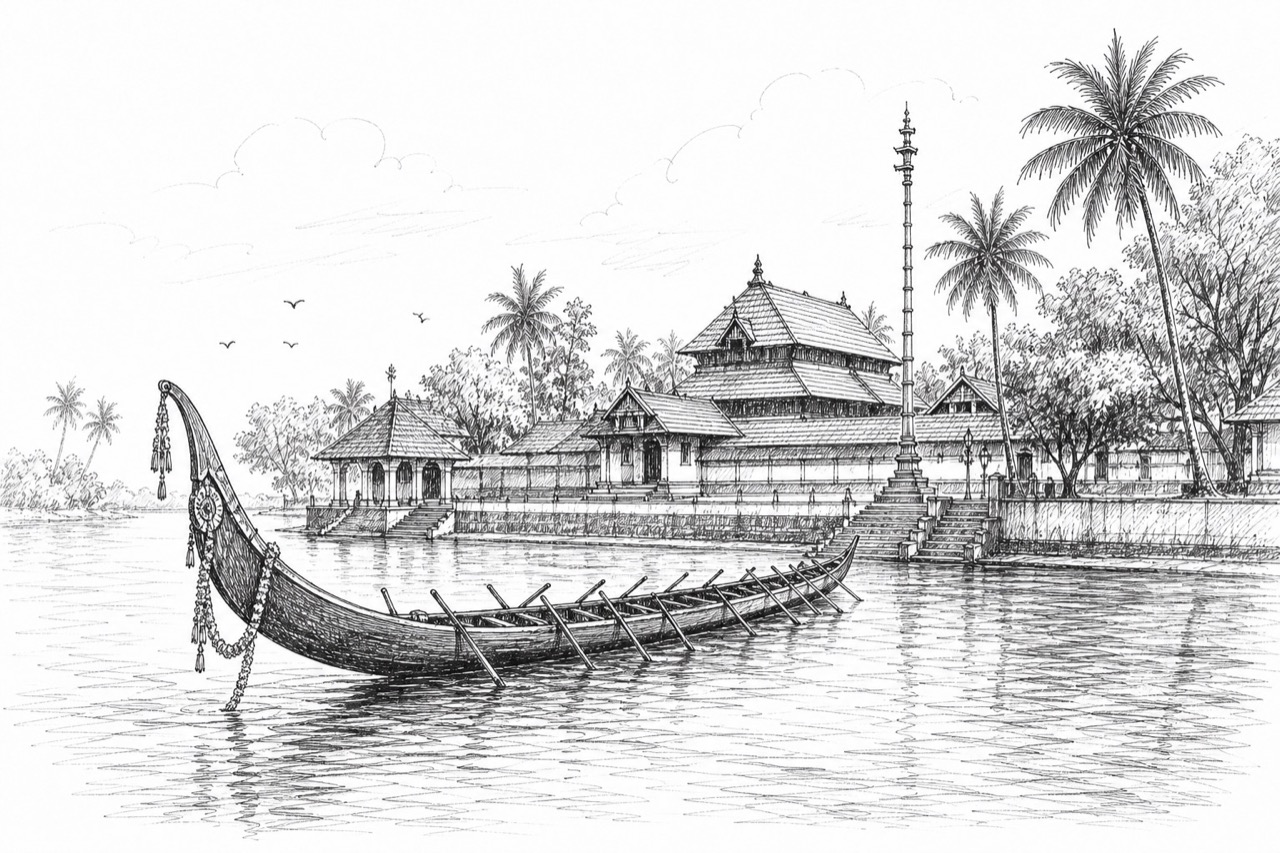
One canonical city journal
Everything for Pathanamthitta and Aranmula, together
A district-centre route through Aranmula’s temple and mirror-making traditions, river country, museums, and forest gateways.
This page consolidates the city’s writing, photographs, mapped stops, practical detail, and locally matched saved places. Regional route pages remain useful for wider context, but this is the stable journal URL for Pathanamthitta and Aranmula.
Kerala trip planner · about 10 minutes
Plan a trip to Pathanamthitta and Aranmula
Start with the essentials, choose a few meaningful sights, and leave room for Kerala’s weather and unplanned discoveries. This guide combines the official English Wikivoyage dump with the journal’s mapped places.
Why visit
Pathanamthitta and Aranmula belongs to Pathanamthitta district and sits within Kerala’s backwater and Travancore country, a low, water-shaped landscape of canals, rivers, paddy fields, market towns, churches, temples and short links into the foothills. The journal works best as a selective guide rather than an instruction to visit every pin. Its strongest themes are water-shaped landscapes; give priority to places that reveal the landscape or community instead of racing between isolated coordinates.
A little history
This part of Kerala was shaped by waterways as much as roads. Agricultural settlements, temple and church centres, river markets and princely Travancore institutions created a dense network rather than one dominant port. Coir, rice, spices, timber and later rubber connected inland communities with the coast. Travancore and Cochin retained princely administrations during British rule, and their Malayalam-speaking territories joined Malabar to form Kerala in 1956. The useful historical scale is local: boat landings, old market streets, sacred compounds and surviving civic buildings explain how communities moved and traded before modern highways reorganised travel.
In and around Pathanamthitta and Aranmula, begin that larger story with Pandalam Palace and Allunkal Dam. A monument or sacred compound is most useful when read together with the street, settlement, waterway or cultivated land around it. Dates and dynasties provide orientation, but living use matters too: ask permission where appropriate, avoid interrupting worship, and distinguish a protected historic structure from a place that still serves an everyday civic or religious role.
Best time and trip length
October to March usually offers the easiest combination of temperature and outdoor time, while the monsoon gives Kerala its saturated green landscape and fuller waterways. Humidity, monsoon rain, water levels and sea or backwater conditions can alter both comfort and access. Festival periods can be culturally rewarding but may change traffic, room availability, dress expectations and access to sacred sites. Check the forecast and district notices shortly before travelling rather than treating a seasonal rule as a guarantee.
Plan a focused half-day, with extra time for the surrounding district. Start early for open landscapes and major sacred or heritage stops, leave the hottest part of the afternoon for a museum, meal or rest, and keep one part of the schedule deliberately empty. That margin absorbs rain, traffic, a longer ferry crossing or the discovery that a place deserves more time than its map marker suggested.
Getting there
The relevant Wikivoyage source material discusses air, rail, bus, ferry or boat and taxi or auto-rickshaw. Use these as transport options, not as a current timetable. For a smaller locality, first identify the district transport hub, then verify the final connection with an official operator, station enquiry or accommodation host. Search by the exact destination name and district because Kerala contains repeated or similarly spelled locality names.
Rail and intercity bus tickets can be constrained around weekends and festivals. A pre-arranged taxi may be sensible for a late arrival, a highland road or a group with luggage, but agree on the fare or meter expectation before departure. Where a ferry is part of the route, allow for weather and service changes and keep a road alternative in mind.
Getting around
Build the day in geographic clusters. Open the journal map, select only the categories relevant to the day, and group stops on the same side of a river, ridge or town centre. Short distances can still take time because of narrow roads, level crossings, ferry schedules and busy junctions. Walking is most rewarding in a compact heritage or market area; elsewhere combine local buses, auto-rickshaws, ferries or taxis according to the terrain.
Keep the place’s actual Google Maps listing open for the final approach, but do not let navigation override a gate sign, protected-area instruction or local advice. Confirm the return journey before entering a remote trail or staying for sunset. At night, use well-lit pickup points and share the vehicle or route details when travelling alone.
Top sights
The following highlights come from the city journal’s own canonical place data, not from a copied directory of businesses. They favour heritage, sacred, cultural and natural sights. The map remains the source for location and category filtering; the notes below explain how to approach each stop thoughtfully.
-
Aranmula Parthasarathy Temple
Place of worship A verified place of worship attraction in this city; check current access and visitor details before going.
-
Pandalam Palace
Palace A verified palace attraction in this city; check current access and visitor details before going.
-
Kadammanittapally
Place of worship A verified place of worship attraction in this city; check current access and visitor details before going.
-
Kodunthara Sri Subrahmanyaswamy Temple
Place of worship A verified place of worship attraction in this city; check current access and visitor details before going.
-
Madathilkkavu Devi Temple
Place of worship A verified place of worship attraction in this city; check current access and visitor details before going.
-
Manjanikkara Dayara
Place of worship A verified place of worship attraction in this city; check current access and visitor details before going.
-
Mathumpadi Devi Temple
Place of worship A verified place of worship attraction in this city; check current access and visitor details before going.
-
Pandalam Mahadeva Temple
Place of worship A verified place of worship attraction in this city; check current access and visitor details before going.
-
Pandalam Valiya Koyikkal kshethram
Place of worship A verified place of worship attraction in this city; check current access and visitor details before going.
-
Sacred Heart Malankara Catholic Church, Mylapra
Place of worship A verified place of worship attraction in this city; check current access and visitor details before going.
Experiences worth making time for
The source coverage and local map point towards heritage walks, sacred places, boating, wildlife watching and walking or trekking. Choose one experience that requires time—a walk, boat journey, performance, nature visit or extended heritage circuit—and let the other stops support it. For forests, reservoirs, wildlife areas and waterfalls, use authorised access, follow seasonal closures and avoid promising yourself a sighting or a particular water level.
Photography should never displace the experience or the people who live there. Ask before photographing worship, ceremonies, performers or residents; observe drone restrictions; and avoid geotagging fragile places where publicity could cause damage. A locally operated walk or guide can add context, but verify credentials and agree on the scope and price first.
A simple itinerary
Morning: choose the most important heritage, sacred or natural place and arrive near opening time. Follow with one nearby secondary stop and an early local lunch. Afternoon: choose a shaded museum, garden, market street or waterside route, then return to an established public area before dark unless a later activity is organised.
If you have a second day: move outward into the landscape—backwater, coast, plantation, forest edge, village craft or a neighbouring historic town according to this journal’s setting. Do not combine distant points merely because the map can draw a route between them. A slower district journey produces a better travel record, reduces repeated driving and leaves time for weather, conversations and unexpected closures.
Food and drink
Backwater cooking makes good use of rice, coconut, fish, duck, tapioca and seasonal produce, alongside vegetarian sadya traditions and bakery or tea-shop snacks. Choose busy local establishments, ask about spice levels and remember that dishes vary significantly between households and districts.
Prioritise well-known local institutions, recommendations supported by the source lists, or clearly busy establishments with visible food turnover. Confirm whether a quoted price includes tax and whether bottled water is sealed. Kerala tea and fresh juices are easy pauses; alcohol availability and rules vary by venue and locality, so do not assume that a bar-like search result is current. The city map intentionally keeps routine eateries out unless they are especially notable.
Money and shopping
India uses the Indian rupee, written as INR or ₹. Carry a modest amount of cash in smaller notes for buses, ferries, market purchases, tips and places where card terminals or mobile data fail. Cards and QR-based payments are common in many towns, but an overseas traveller should confirm that a particular card or payment app will work before relying on it. Use bank-affiliated ATMs, shield the keypad and decline unofficial offers to exchange money.
Buy fewer things with a clearer local connection: spices, tea or coffee near their producing regions; coir and fibre work around the backwaters; handloom, craft, books or food products from established sellers. Check packaging and transport restrictions for plant, wildlife, antique or religious objects. Bargaining may be normal in some informal settings but not in fixed-price shops; remain courteous and walk away rather than turning the exchange into a contest.
Where to stay
Choose the location before the room category. A central stay makes an early heritage walk, station transfer or evening meal easier; a beach, backwater, plantation or forest-edge stay trades convenience for landscape. Check recent reviews for cleanliness, noise, road access and the reliability of hot water or air-conditioning. In highland and nature areas, ask about the final road, mobile signal and night transport before paying.
Confirm the full price, cancellation terms, check-in identification and any taxes directly with the property. A homestay can provide valuable local context when it is properly registered and expectations are clear. Never assume that a dramatic view grants access to neighbouring private land, plantations, rooftops or waterways.
Safety, respect, language and internet
Travel safely and respectfully
Kerala is accustomed to visitors, but ordinary precautions still matter. Protect valuables in crowded transport, use established operators at night, and be cautious around isolated beaches, fast water, slippery laterite or forest paths. Monsoon rain can produce flooding, rough seas, landslips and sudden changes at waterfalls. Follow official closures even when another visitor says the route was open recently.
Dress and behave conservatively at places of worship; footwear, photography and entry rules differ by site. Ask before entering ceremonies or private compounds. Wildlife must be observed from the required distance, and feeding animals creates risks for both people and animals. Carry prescribed medicine, sun and rain protection, and the contact details of the accommodation. For an emergency in India, use the national emergency number 112.
Language and staying connected
Malayalam is the principal language. English is widely useful in tourism and many urban settings, but a greeting and patient pronunciation of the destination name help. Show the name in writing when spellings vary. Mobile coverage is generally useful in settled areas yet can weaken in the Ghats, forest edges and on some water routes; download the city bundle or map before leaving reliable service.
Use official tourism, transport, protected-area and district channels for time-sensitive information. A map review, local confirmation and one backup plan are more reliable than repeating an old opening time from any travel guide—including this one.
Where to go next
Continue within the district before making a long transfer. This keeps the geographical story coherent and makes it easier to compare coast, backwater, plain or highland without losing a day to transit. The following links combine nearby Traveling Gander journals with destinations mentioned by the corresponding Wikivoyage source where available.
Wikivoyage sources, contributors and CC BY-SA 4.0 licence
The August 2026 English Wikivoyage dump contains dedicated guides for Pathanamthitta and Aranmula. This journal reorganises the durable orientation from those guides and combines it with the locally verified map. Timetables, prices, entry rules and individual businesses have deliberately not been copied as permanent facts.
This adapted planning guide uses the 2026-08-01 English Wikivoyage dump. Source revisions:
- Pathanamthitta revision 5298345 · contributors and history
- Aranmula revision 3702455 · contributors and history
- Kerala revision 5302933 · contributors and history
The adapted guide text inside this section is available under the Creative Commons Attribution-ShareAlike 4.0 licence. It has been condensed, reorganised and combined with Traveling Gander’s independent map data. No Wikivoyage images were reused. See Wikivoyage’s reuse guidance.
Consolidated journal
Descriptions, photographs, and details
The entry below preserves the useful material that previously lived inside a broader regional route.
Pathanamthitta and Aranmula
Aranmula’s temple and metal-mirror traditions, museums, river landscapes, and gateways toward forest country.
Open city mapBroader route context remains in the source travel guide.
Personal shortlist
Want to Go places around Pathanamthitta and Aranmula
These pins come from the personal Google Maps Want to Go collection and fall inside this city’s mapped boundary or local radius. Every matching pin is available on the searchable map above.
No saved Want to Go pins currently fall inside this journal’s mapped area. Curated journal stops still appear on the map above, and the complete saved places collection remains available.
Journal notes
Use this as a living travel record
Verify current access
Opening hours, permits, transport, weather, and local rules can change after a journal entry is written.
Read the map selectively
The saved list is a set of possibilities, not a checklist. Filter it and build a route around one compact area at a time.
Distinguish visits from ideas
Green journal stops are documented or photographed; red Want to Go pins remain future possibilities.
Add the next chapter here
Future descriptions and photographs now have one stable city page instead of being split among collection pages.